


.png)
Educational Disclosure: This article is provided for general educational purposes only. It does not constitute employment, legal, pension, unemployment, tax, insurance, investment, or retirement advice. State Employee Advisor Network is a marketing and referral platform operated by Revenx LLC. SEAN does not represent employees in workplace disputes, determine benefit eligibility, calculate pension rights, or provide career-transition services. Official information must come from the employing agency, Indiana State Personnel Department, Indiana Department of Workforce Development, Indiana Public Retirement System, or an appropriately qualified professional.
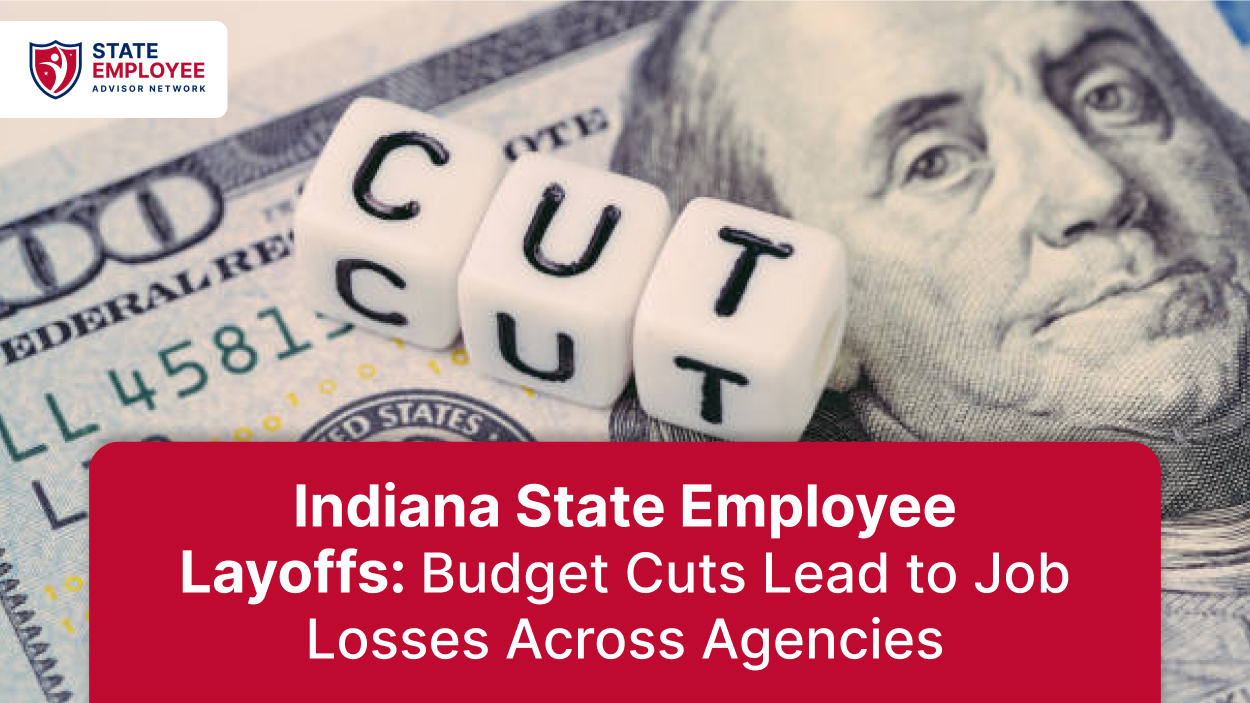
Indiana state agencies implemented layoffs and eliminated vacant positions in 2025 after lawmakers approved a two-year state budget containing reductions across several departments.
Education, library, tourism, workforce, and economic-development organizations were among the areas affected.
The reductions created immediate concerns for employees who lost their jobs and for workers wondering whether additional positions could be affected. However, the available information does not support treating every decline in state-government headcount as a layoff or assuming that another statewide reduction is certain.
Employees should distinguish among:
Each event can have different implications for employment rights, benefits, unemployment insurance, and retirement accounts.
The most clearly documented round of state-agency layoffs occurred in June 2025 as agencies prepared for the new biennial budget.
Reported reductions across education-related agencies included:
Officials also reported the elimination of 43 vacant education-related positions.
The Indiana Historical Bureau, which operates within the State Library, reportedly lost five of its six employees. These reductions affected staffing connected with state historical markers and other public-history programs.
The totals should be described carefully. Laid-off employees and eliminated vacant jobs are both staffing reductions, but a vacant position does not represent an additional worker losing employment.
Commerce-related organizations also reported staffing cuts.
The live article identifies:
Contemporary reporting described 12 reductions across the commerce-related organizations and projected more than $7 million in annual savings.
The exact financial effect should not be presented as guaranteed because savings can depend on salary, benefits, replacement hiring, restructuring, contracts, and future appropriations.
The layoffs followed passage of Indiana’s two-year spending plan.
Lawmakers and state officials were responding to a weaker revenue outlook and an estimated budget gap of approximately $2 billion relative to earlier spending expectations.
Budget reductions affected multiple agencies. Reported examples included:
The phrase “$2 billion shortfall” should not be interpreted as the state missing $2 billion in cash or being unable to pay all obligations. It generally referred to the difference between expected resources and proposed or previously anticipated spending.
The budget and resulting staffing decisions were political and administrative choices. The available sources document both the reductions and criticism from affected employees, but they do not establish the long-term service effect with certainty.
The live article states that Indiana government employment declined from 32,212 employees in December 2024 to 31,513 in June 2025.
That represents a net decline of 699 positions in the reported headcount.
It does not necessarily mean 699 people were laid off.
A workforce total can decline because of:
The confirmed agency-level layoff totals should therefore be reported separately from the statewide headcount change.
Ivy Tech Community College separately announced a workforce reduction affecting more than 200 employees amid funding and organizational changes.
That reduction was significant, but it should not automatically be added to the executive-branch state-agency layoff count.
Ivy Tech is a statewide public community-college system with its own employment and administrative structure. Its workforce decisions may be influenced by state appropriations, but its employees and procedures should be discussed separately from layoffs directly administered by state agencies.
Publicly available information reviewed for this update confirms the 2025 reductions but does not establish a new, comparable statewide layoff round for 2026.
Indiana’s overall labor market also should not be confused with the state-government workforce. In June 2026, the Indiana Department of Workforce Development reported:
These figures describe the broader Indiana economy, not job security inside a particular agency.
Employees should rely on written notices, agency communications, official personnel policies, and state budget actions rather than rumors or statewide private-sector layoff data.
Indiana’s State Personnel Department publishes a standardized Layoff and Recall Policy, effective March 2, 2026.
The policy applies only to the agencies and employees identified within its scope. Separate statutes, civil-service rules, agency policies, collective bargaining provisions, or employment agreements may also apply.
A layoff may involve issues such as:
The live article’s statement that Indiana’s at-will doctrine permits termination at any time does not adequately explain a state layoff.
Even in an at-will jurisdiction, an employer cannot terminate someone for an unlawful reason. Public employment can also involve procedural rights that do not apply to a typical private-sector employee.
An affected worker can request copies of:
Legal questions require review by an appropriately qualified attorney or employee representative.
The federal Worker Adjustment and Retraining Notification Act may require advance notice for certain mass layoffs or plant closings involving covered employers.
It does not apply to every workforce reduction.
Coverage depends on factors including:
The Indiana Department of Workforce Development maintains a public WARN-notice database and transition resources for affected workers.
The state-agency layoffs described in the live article should not be labeled WARN violations or WARN-covered events without a legal and fact-specific analysis.
A worker unemployed through no fault of their own may be eligible for Indiana unemployment insurance.
Claims must be filed through the state’s Uplink system. Indiana DWD determines eligibility based on wages, separation reason, availability for work, job-search activity, and other requirements.
As of 2026:
A layoff does not automatically guarantee benefits. DWD makes the formal determination.
Employees should keep:
Loss of employment can also end active employee health coverage.
The Indiana State Personnel Department states that COBRA information is mailed to the employee’s home address after the termination is entered in the state’s PeopleSoft system.
The packet should explain:
COBRA generally allows continued participation in the group plan, but the former employee may need to pay the full premium plus an administrative charge.
Other possible coverage sources may include:
The coverage date and cost should be verified before active insurance ends.
Many eligible Indiana state and local government employees participate in the Public Employees’ Retirement Fund, or PERF, administered by the Indiana Public Retirement System.
PERF has two primary structures:
The Hybrid Plan includes:
A member generally becomes vested in the Hybrid pension after 10 years of creditable service, although certain elected officials have a different schedule.
Leaving employment does not require an immediate withdrawal.
A separated member may be able to:
Taking money out can create tax consequences and may affect future retirement benefits.
My Choice is a defined-contribution-only plan.
Members are always vested in their mandatory employee contributions. Employer contributions generally vest gradually over five years:
A layoff does not automatically mean the account must be cashed out.
Before making a decision, verify the plan, vested percentage, account balance, tax withholding, rollover options, and possible future public employment through INPRS.
An employee receiving a layoff notice can use this administrative checklist:
Employees should not send passwords, full Social Security numbers, or sensitive personnel documents through unsecured email.
The live article links to the separate guide on State Department RIFs.
That article concerns federal employees and federal reduction-in-force procedures. Federal civil-service rules should not be applied to an Indiana state-agency layoff.
State Employee Advisor Network is a marketing and referral platform operated by Revenx LLC. We connect consumers with independent, licensed financial professionals.
SEAN does not provide employment law, career placement, unemployment representation, pension administration, investment advice, tax advice, legal advice, or insurance advice.
Professionals participating in the network are independent third parties. They are not employees or representatives of SEAN. All services, analysis, guidance, and recommendations come solely from the professional.
The introduction is free to consumers. Revenx LLC receives compensation from participating professionals for marketing and referral services. This creates a financial incentive to refer consumers to participating professionals.
Consumers should independently evaluate each professional’s licensing, registrations, Indiana public-benefit experience, services, fees, compensation, conflicts of interest, and disciplinary history.
Schedule a free introduction to an independent professional.
Indiana’s confirmed 2025 state-agency layoffs affected employees across education, library, tourism, workforce, and economic-development organizations. Agencies also eliminated vacant positions as they adjusted to the state’s two-year budget.
The documented layoff counts should not be combined with all government headcount declines, Ivy Tech reductions, or private-sector WARN notices.
Affected employees may need to review several separate systems:
Official written records from the employer, Indiana SPD, DWD, and INPRS should remain the primary sources.
Reports identified 39 layoffs across education-related agencies and additional commerce-related reductions in June 2025. Vacant positions were also eliminated, but those should not be counted as employees losing jobs.
Not necessarily. The reported government headcount declined by approximately 699 between December 2024 and June 2025, but that net change can include resignations, retirements, vacancies, and other separations.
The sources reviewed for this update do not establish another comparable statewide round. Employees should monitor official agency and Indiana SPD communications.
Possibly. Indiana DWD determines eligibility. The claimant must generally be unemployed through no fault of their own, meet wage requirements, and remain able, available, and actively seeking work.
Indiana DWD currently lists a maximum weekly benefit amount of $390.
Active coverage may end according to the state plan’s rules. Indiana SPD states that COBRA information is mailed after the termination is recorded.
No. The effect depends on whether the employee participates in PERF Hybrid or My Choice and whether the member is vested. Leaving employment does not automatically require an account withdrawal.
No. State personnel policies, civil-service provisions, contracts, discrimination laws, recall procedures, and position-specific protections may apply.

Jeremy contributes regularly to State Employee Advisor Network. With a deep understanding of state pension systems and public-sector benefits, he offers readers insights and strategies to optimize their retirement outcomes.



State Employee Advisor Network is a marketing and referral platform operated by Revenx LLC. We connect consumers with independent, licensed financial professionals. We are not a registered investment adviser, broker-dealer, or insurance agency, and we do not provide investment, legal, or tax advice.
All financial services are provided solely by third-party professionals. Revenx LLC receives compensation from financial professionals for marketing and referral services, which may create a financial incentive to refer individuals to participating professionals. Users should independently evaluate any financial professional before engaging their services.
.png)
.png)

.jpg)